


Fishing spiders
Fishing spiders
These are actually pictures that I took well over a year ago, but have not posted as yet….despite them being among my fave predation pics. This was the first time I had come across a fishing spider actually eating its prey (I have since seen it twice more, just once more able to photograph it).
This was found at Lions Nature Education Centre, at the very small ornate pond, in-between the Deaf cafe/Lotus pond. I was actually looking for checkered keel back snakes that I often find around there when this tiny spider caught my eye….like a mini-leopard in its hunting and power.
Both pictures were taken with a Canon R5, with a canon 100-500mm L IS USM lens.
The first scene was at 500mm, 1/200s f/14 ISO400. Handheld. Godox 100AD pro flash unit with homemade diffuser.
For the second I wanted a really close up macro, tricky with a zoom/telephoto lens, but I went down 123mm, and put a Redox aftermarket 50mm extension ring on (for closer focusing/not magnification), which allowed me to get much closer to the subjects. 1/200s f/16 ISO200. Handheld. Godox 100AD pro flash unit with homemade diffuser.

This is a Pond Fishing Spider from the genus Dolomedes, and it is a medium sized, semi-aquatic nursery-web spider common in Hong Kong wetlands. When I first discovered this scene early one morning in a pond just behind my house, I could see that the droplet of water draining off the head of the tadpole — a giveaway that the prey was taken from the water surface; and what I knew about this spider is that they almost always retreat to a stem or leaf to consume captured aquatic prey. The spider is clinging to vegetation with its legs splayed outward, holding prey beneath the chelicerae.Fishing spiders do not use webs, they use hydrophobic hairs on their legs to spread their weight and stay on the surface tension of water, using only touch, vibration and stealth. I have since read that Dolomedes spiders can detect heartbeats of tadpoles through surface vibrations.
A big note of thanks to Marco and Kuan-ping who are spider experts, and who helped me move back from an erroneous species ID and back to a safer genus. If you want some great, deep, academic writing and research on “Dolomedes fishing spider biology: gaps and opportunities for future research” follow this link: https://www.frontiersin.org/journals/arachnid-science/articles/10.3389/frchs.2024.1501653/full
This was a technically difficult shot, in the low early morning light and in the shade from the trees and also it was tucked under the leaves. I had to lie in the shallow water of the pond - about 1.2m away given the focus distance of the lens I was using - which would also give me good bokeh at that distance, even at f14. As it was handheld I used 1/200s to keep it sharp from any movement by myself, and f14 kept all the subject in sharp focus while filling the frame. I kept the whole plant in to show the size. Using an off camera flash with a large homemade diffuser gave a lovely soft light across the whole scene.
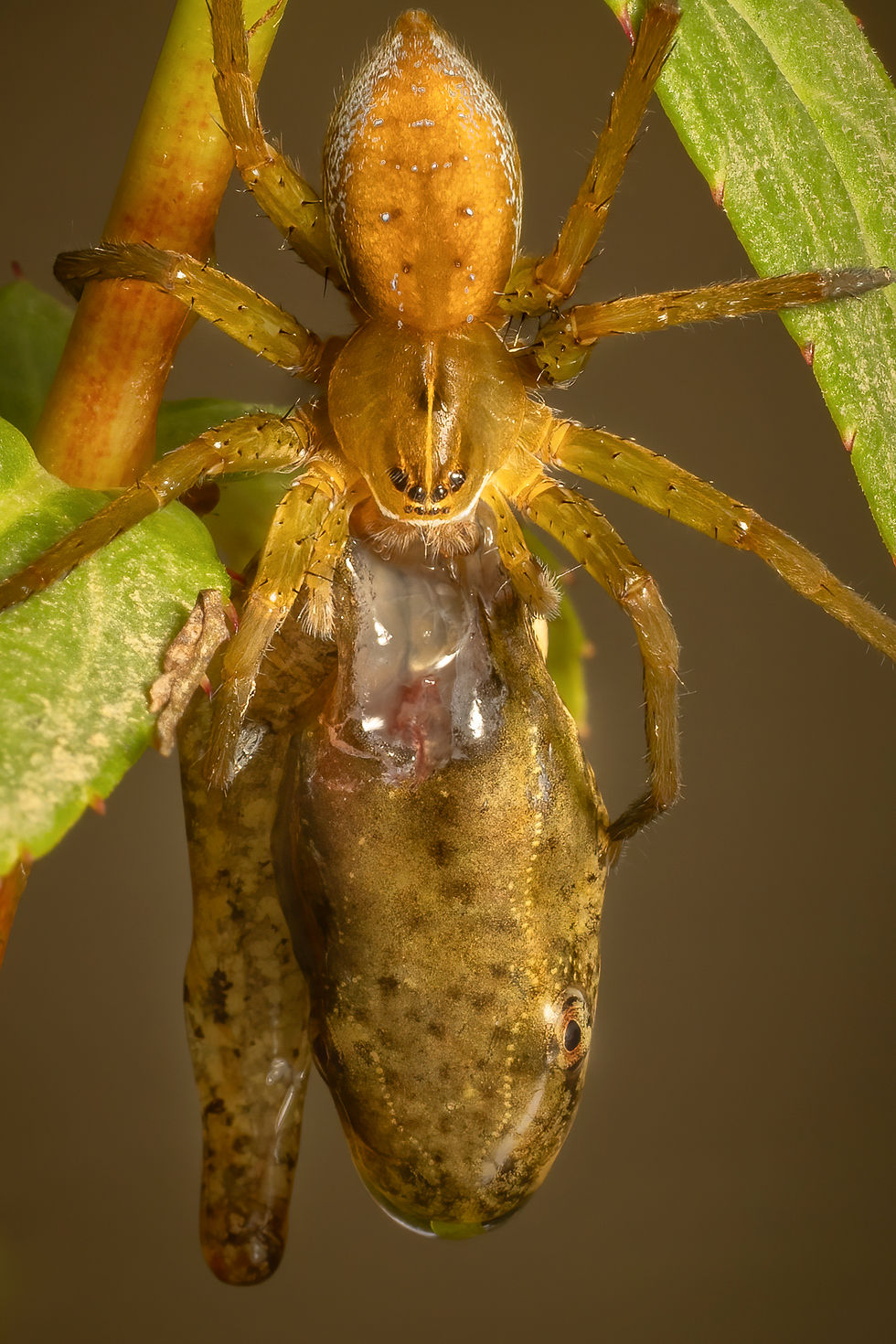
For my macro shot: I used extension rings to be able to halve the focusing distance of the lens to 60cm - and I shut down to keep the subject in focus at f16. As it was handheld I used 1/200s to keep it sharp from any movement by myself, and f16 kept all the subject in sharp focus while filling the frame. I decided to show the body of the tadpole, which looks almost like a frog, and the way the flesh of the prey animal has been cut and softened by the venom and fangs of its predator. Using an off camera flash with a large homemade diffuser gave a lovely soft light which I could direct onto the spider and its prey, without harsh shadows.
This I also found interesting, but my source for this is Wikipedia, and about a specific species. Since males are generally able to escape female attacks after copulation, they are able to mate again. Furthermore, while males do not seem to discriminate between virgin and non-virgin females in courting, females are unlikely to mate a second time and exhibit aggressive behaviour towards males after their first copulation.Evidence from field observations in Alberta, Canada (mating behaviours may vary based on location) suggests that D. triton is protandrous, meaning that males that emerge earlier have greater access to the limited resource of virgin females, a mating system that resembles ‘scramble competition polygyny,’ where competition for mates takes the form of a race between competitors. Furthermore, males gain an advantage if they are able to copulate more quickly, allowing them to move on to another female.
Also, and this I have witnessed in Hong Kong on water spiders : As an anti-predator response, air and water borne vibrations act as stimuli leading spiders to dive underwater and grab hold of a submerged substrate, such as aquatic vegetation or submerged rocks. An air capsule covers the spider, allowing the spider, if healthy, to re-emerge from the water completely dry. Submergence durations of up to 90 minutes have been observed.
Comments